7 Factors to Consider When Ordering Custom Bearings
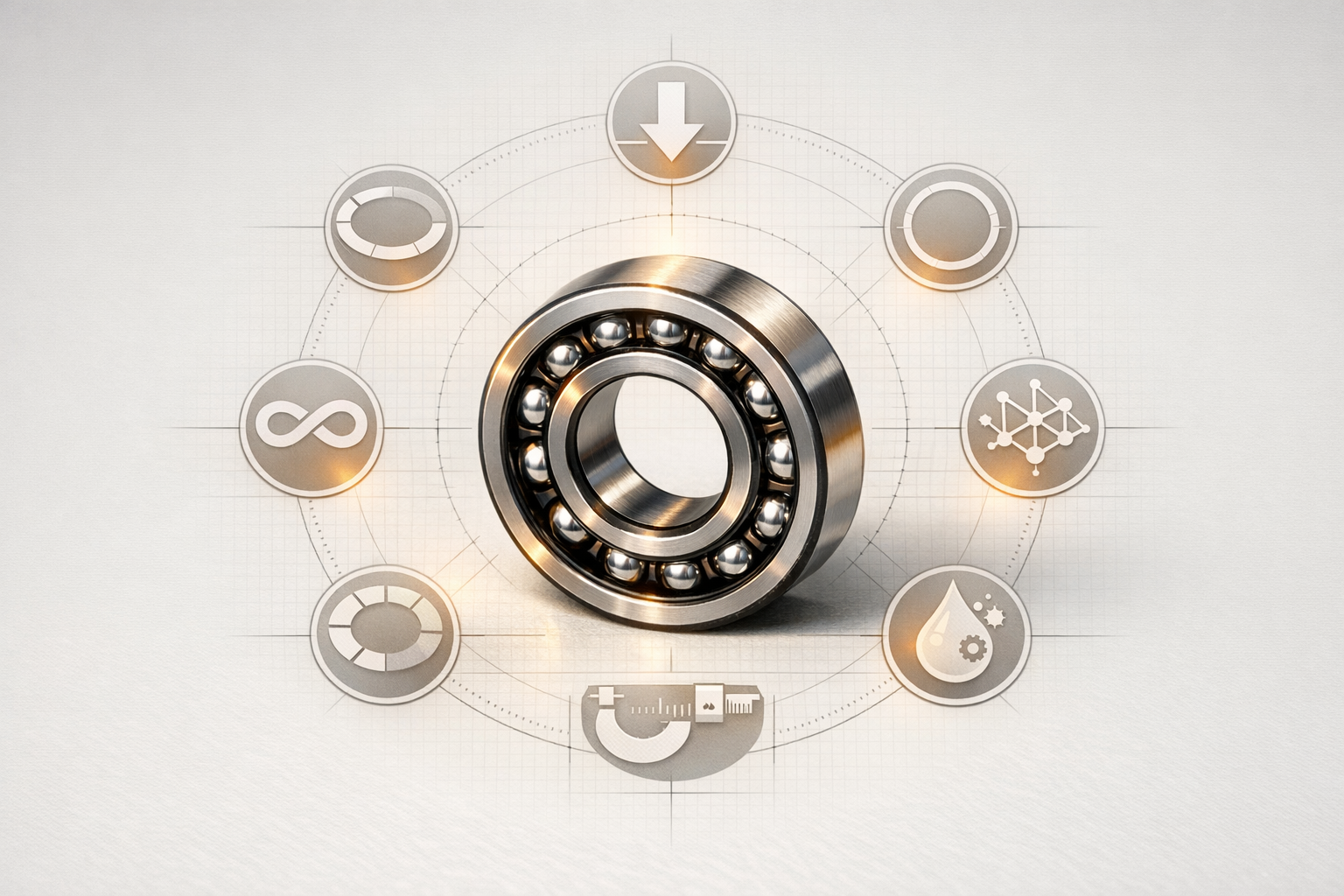
When ordering custom bearings, you need to focus on the specific demands of your application. Custom bearings outperform standard options in precision, durability, and adaptability to tough conditions. Here's what to consider:
- Load Capacity and Type: Understand if the bearing will handle radial, axial, or combined loads. Misjudging this can lead to failure.
- Dimensional Tolerances and Sizes: Precise measurements for bore, diameter, and width ensure a proper fit and performance.
- Material Selection: Choose materials like chrome steel, stainless steel, or ceramics based on load, speed, and environmental conditions.
- Operating Environment: Factors like temperature, moisture, and contamination impact bearing lifespan and performance.
- Precision and Rigidity: For high-speed or high-load uses, select bearings with higher precision (e.g., ABEC 7 or 9) and rigidity.
- Customization Options: Features like seals, lubrication, and coatings can improve durability and efficiency.
- Lifecycle and Costs: Evaluate total ownership costs, including maintenance, downtime, and replacement expenses.
Key takeaway: Custom bearings are tailored to meet unique challenges, such as extreme temperatures, high speeds, or precision needs. By addressing these seven factors, you can ensure optimal performance and long-term reliability.
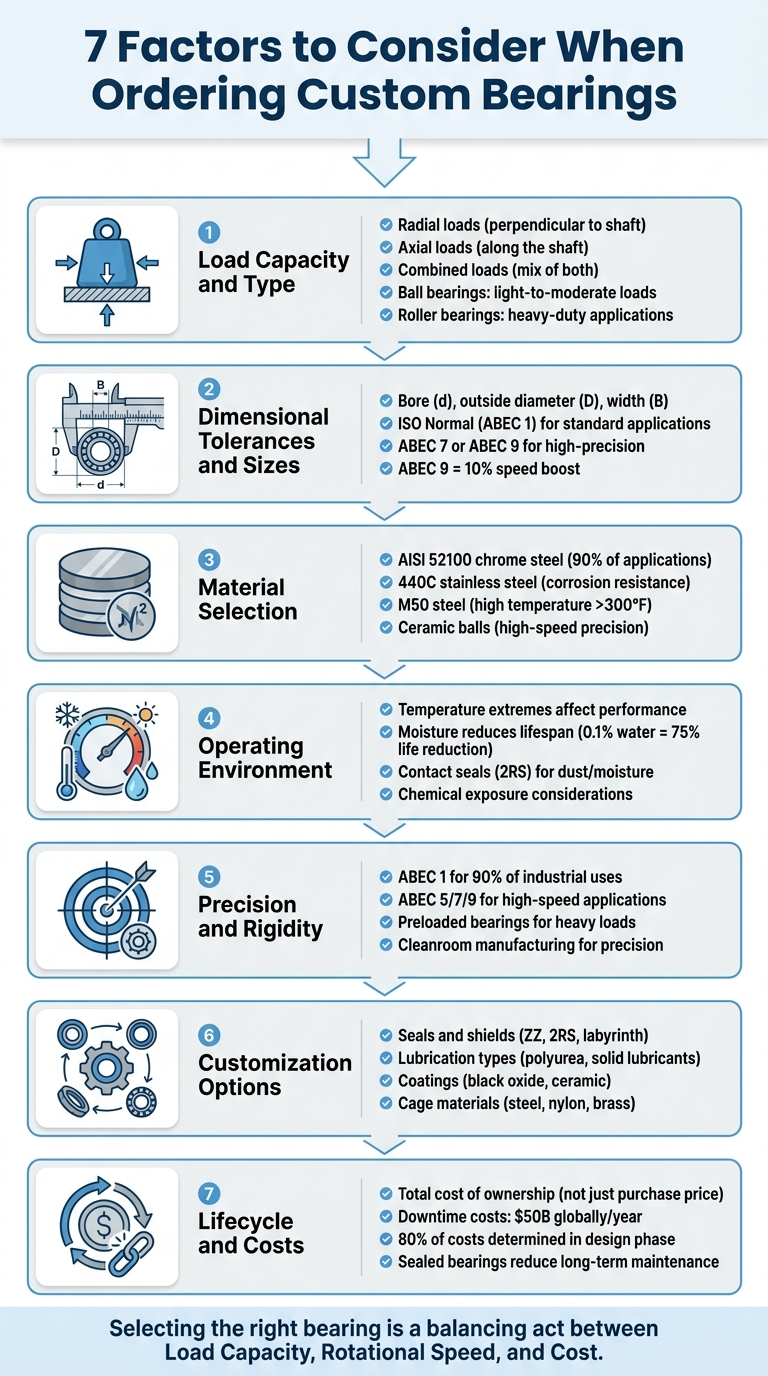
7 Essential Factors for Ordering Custom Bearings
HOW TO SELECT THE RIGHT BEARINGS FOR YOUR APPLICATIONS: YOUR GUIDE TO PRECISION
sbb-itb-d28dc3f
1. Load Capacity and Type
When ordering custom bearings, the first thing to figure out is the type and amount of force your application will generate. Bearings typically handle three types of loads: radial loads (acting perpendicular to the shaft), axial loads (acting along the shaft), and combined loads (a mix of both). These distinctions are key to picking the right bearing for your needs.
Getting the load calculation wrong can lead to early bearing failure. Ball bearings, for example, use point contact, making them suitable for light-to-moderate loads at high speeds - think electric motors. On the other hand, roller bearings use line contact, which spreads the pressure over a larger area, making them better for heavy-duty machinery like crushers or axles.
"Rarely can these kinds of loads be determined by simple calculations. As the load is not always constant and the load fluctuates in many cases, it is difficult to determine the frequency and magnitude of the fluctuation." - Kevin Sweeney, Founder and CEO, Pacific International Bearing Sales Inc
To better assess these loads, focus on two important ratings. The Dynamic Load Capacity (C) tells you the constant radial load a bearing can handle for one million revolutions. Meanwhile, the Static Load Capacity (C0) indicates the maximum load a stationary bearing can take without deforming. For bearings exposed to combined loads, you can use the equivalent radial load formula ($P = XFr + YFa$) to consolidate multiple forces into a single number that can be compared to catalog ratings.
In applications with high loads, don’t forget to consider thermal expansion. A floating (cylindrical roller) bearing on one end of the shaft can accommodate axial movement while still managing radial loads effectively.
2. Dimensional Tolerances and Sizes
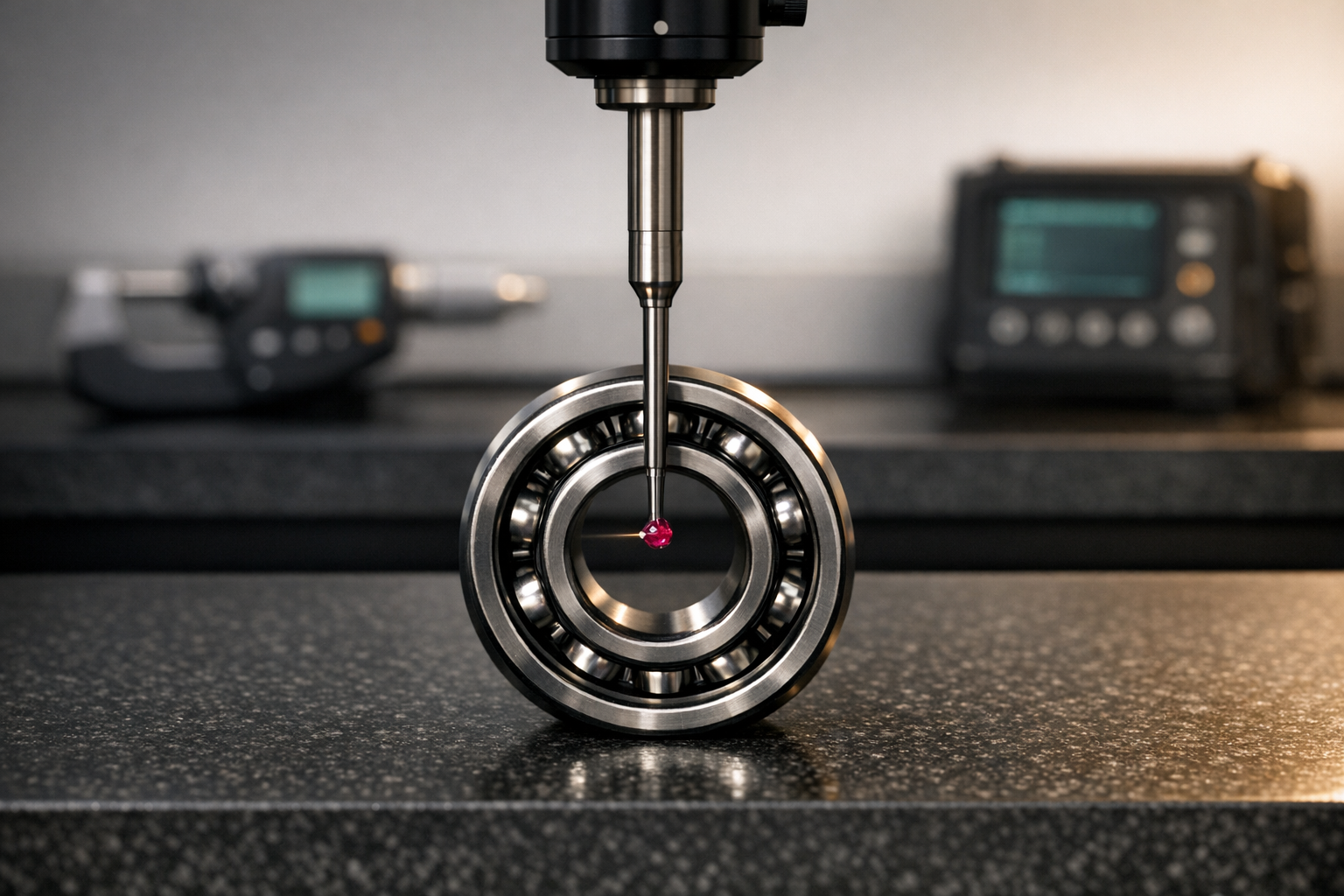
Once you've determined the load requirements, the next step is to ensure precise dimensions. Bearings need exact measurements for the bore (d), outside diameter (D), and width (B) to ensure a proper fit. For most standard applications, ISO Normal (ABEC 1) tolerances are sufficient. However, high-precision applications may require ABEC 7 or ABEC 9 tolerances. It's worth noting that moving from ABEC 7 to ABEC 9 can boost the speed rating by about 10%. Without the correct fit, even the best performance specifications become irrelevant. Proper dimensions are essential for applying strict tolerance classes effectively.
Pay attention to the chamfer - the rounded edge of the bearing. This needs to be larger than the shaft or housing fillet radius. If these don't align properly, the bearing won't seat flush, which can cause misalignment and lead to premature failure.
The precision of a bearing is only as good as the accuracy of the entire assembly. For example, installing a high-precision bearing on a shaft with loose tolerances can cause the bearing to deform, negating the benefits of its tight tolerances. When ordering custom bearings, make sure the mating shaft and housing are machined to match the bearing's precision class. Whenever possible, aim to design around widely available standard sizes - like the 6203 bearing - to take advantage of cost savings before considering custom dimensions.
3. Material Selection
Choosing the right material for bearings is crucial for managing stress, resisting corrosion, and performing under various thermal conditions. For about 90% of applications, AISI 52100 chrome steel is the go-to option. It’s highly wear-resistant and capable of deep hardening, making it ideal for handling heavy loads. However, it does have some limitations, including reduced resistance to softening at higher temperatures and minimal protection against corrosion.
"AISI 52100 is a moderately deep hardening alloy with high-resistance to wear, medium toughness, and low-resistance to softening at elevated temperatures."
– Kevin Sweeney, Founder and CEO, Pacific International Bearing Sales Inc.
For environments like fresh water, food processing, or mild acid exposure, 440C stainless steel is a better choice. It offers comparable load capacity and RPM performance to chrome steel but with significantly better corrosion resistance. If even greater corrosion protection is needed, Cronidur®30 is a step up, providing extended wear life and enhanced resistance compared to 440C.
In high-temperature scenarios exceeding 300°F, M50 bearing steel is the material of choice. It maintains excellent wear resistance and structural integrity, even under extreme heat. For high-speed and precision applications - such as spindles - hybrid bearings that combine ceramic balls with steel races can reduce friction and handle higher operating speeds.
Matching the material to the operating environment is essential. For settings prone to moisture or caustic conditions, 440C or Cronidur®30 are smart options. For applications requiring ultra-high speeds, ceramic balls are the way to go. Selecting the right materials and precision grades can enhance performance by as much as 10–20%. This thoughtful selection process lays the groundwork for addressing environmental and operational demands in subsequent design stages.
4. Operating Environment and Conditions
The conditions in which a bearing operates can drastically affect its performance and lifespan. Temperature fluctuations, for example, have a significant impact. Extreme heat speeds up wear by degrading lubricants, while freezing temperatures increase lubricant viscosity and can even solidify oil if it drops below its pour point. Additionally, the mismatch in thermal expansion between steel components can lead to bearing seizure. Because of this, materials that can resist thermal expansion are crucial.
"Unlike steel, which expands significantly with increasing temperature, ceramic materials exhibit minimal thermal expansion... reducing the risk of seizure and dimensional deformation."
– Kevin Sweeney, CEO, Pacific International Bearing Sales Inc
Ceramic materials like Si3N4 (silicon nitride) or ZrO2 (zirconia) offer superior heat resistance, tolerating temperatures up to 2,912°F (1,600°C), far beyond the 932°F (500°C) limit of high-temperature steel. On the other hand, in extremely cold conditions, materials like 316 stainless steel and full ceramic bearings can function as low as -328°F (-200°C). However, it’s worth noting that full ceramic bearings generally handle only 30% to 50% of the load capacity of standard steel bearings.
Moisture and chemical exposure pose additional challenges. Even a small amount of water - just 0.1% - can reduce a bearing's lifespan to 25% of its expected duration. With 1% water ingress, a bearing designed to last four years might fail in just three months. For humid or corrosive environments, contact rubber seals (2RS) are highly effective at keeping out moisture and dust, though they come with a trade-off: a 30% to 35% reduction in limiting speed due to added friction. In washdown settings like food processing, solid lubrication - a polymer matrix infused with oil - prevents grease washout and eliminates the need for frequent relubrication.
Real-world examples highlight the importance of choosing bearings suited to their environment. A European steelmaker, for instance, cut quarterly failures down to annual maintenance, saving about $15,400 per year. Similarly, a cement manufacturer extended bearing life from 2–3 months to over a year, resulting in savings of approximately $36,300 annually. These cases emphasize how understanding environmental factors can lead to significant improvements in bearing performance and cost efficiency in demanding applications.
5. Precision and Rigidity Requirements
Precision and rigidity are crucial for ensuring bearings perform accurately under load and at high speeds. Precision refers to how accurately a bearing is machined and how smoothly it spins without deviations (runout). On the other hand, rigidity - or stiffness - measures how much a bearing deforms elastically when force is applied. Together, these factors significantly affect machine performance, particularly in situations where even slight inaccuracies can disrupt quality or safety. This is especially important in high-speed and high-load environments.
For most industrial applications - about 90% - standard precision bearings (ISO Class 0, ABEC 1) are sufficient. These bearings are ideal for equipment like conveyors, general-purpose motors, and agricultural machinery. However, more demanding applications, such as CNC spindles, aerospace actuators, or high-speed medical devices, require higher precision bearings like ABEC 5, ABEC 7, or ABEC 9 (ISO P4 or P2). Opting for ABEC 9 bearings can increase operational speed by approximately 10%, and incorporating hybrid ceramic ball bearings can further boost speed by another 10%. These enhancements are critical in high-performance settings where efficiency and precision are non-negotiable.
Rigidity is equally important when the shaft must maintain its position under heavy loads or cutting forces. Without sufficient rigidity, issues like shaft deflection can arise, leading to poor surface finishes, tool damage, or gear misalignment. To address this, engineers often use preloaded angular contact ball bearings or tapered roller bearings. These designs eliminate internal play, ensuring the bearing remains stable even under dynamic loads.
To achieve optimal performance, high-precision bearings must be paired with shafts and housings machined to tight tolerances, such as H7/m6 fits, to avoid deformation that could compromise accuracy. Additionally, these bearings are often manufactured in ISO 6, Class 1000 cleanroom environments to prevent contamination from dust or particles. This level of precision manufacturing can sometimes triple the cost compared to standard-grade bearings.
For applications that demand both exceptional precision and rigidity - like robotics, satellite systems, or wind turbine main rotors - selecting the right combination of precision class, preload, and fit type is essential. This ensures the bearing maintains its dimensional stability and delivers reliable performance throughout its service life.
6. Customization Options and Features
When it comes to fine-tuning bearing performance, customization plays a key role. Adjustments like seals, shields, coatings, cage materials, and lubrication systems can significantly improve efficiency and durability. These custom modifications address specific challenges unique to each application, ensuring optimal performance.
"A single suffix in a specification code - denoting clearance, cage material, or grease type - is often the difference between a machine that runs smoothly for years and one that fails in weeks."
– TFL Bearings
Sealing and Shielding Options
Sealing and shielding are critical for protecting bearings from environmental factors. For clean, high-speed operations, metal shields (ZZ) are a top choice, as they maintain full speed capacity. On the other hand, rubber contact seals (2RS) offer better protection against water and dust but come with a trade-off - speed capacity may drop by 30% to 35% due to heat from friction. In harsher conditions, labyrinth seals provide non-contact protection against splashing liquids without adding friction. A notable example comes from October 2025, when PBC Linear designed a custom solution for a woodworking manufacturer, extending bearing life from just one week to over a year by incorporating periodic lubrication.
Lubrication Customization
Lubrication is another area where customization can make or break a bearing's lifespan. Improper lubrication is responsible for more than half of premature bearing failures. For electric motors, polyurea grease can last three to five times longer than standard lithium grease. Adjusting fill rates is also crucial - high-speed spindles perform better with lower fill rates (15%–20%) to minimize drag, while environments with high contamination may need higher fill rates (50%–90%). In wash-down applications, solid lubricants embedded in a polymer matrix are particularly effective, as they resist being washed away.
Advanced Coatings and Heat Treatments
For enhanced protection, advanced coatings and heat treatments are indispensable. Black oxide coatings improve rust resistance, while zinc or nickel plating provides superior defense in wash-down settings. In electric vehicles or motors with variable frequency drives (VFDs), ceramic coatings (aluminum oxide) on rings prevent electrical fluting caused by stray currents. Additionally, heat stabilization treatments allow bearings to maintain hardness and perform reliably at temperatures up to 300°C (572°F).
Cage Material Selection
The choice of cage material has a significant impact on a bearing's speed, noise level, and durability. Pressed steel cages are the standard for most applications, accounting for around 80% of use cases. For high-speed motors, glass-fiber reinforced nylon (TN9) reduces friction and noise but is limited to temperatures below 120°C (250°F). In more demanding environments, such as mining or wind turbines, machined brass cages excel due to their ability to handle severe shock loads and high vibration.
"The life can be multiplied many times by engineering a custom solution."
– GMN Bearing USA
7. Lifecycle, Endurance, and Cost Factors
When evaluating custom bearings, it’s essential to look beyond the initial purchase price and consider the total cost of ownership. This includes not just the cost of the bearing itself but also expenses tied to installation, energy use, maintenance, spare parts, and downtime. Equipment downtime alone is a massive financial burden for industrial manufacturers, with an average of about 800 hours of downtime annually. Globally, unplanned stoppages cost an estimated $50 billion per year, with the 500 largest manufacturers losing around 11% of their annual revenues - equivalent to $1.4 trillion in lost value. These numbers highlight how critical it is to factor in both performance and reliability when selecting bearings.
"Cost is, or should be, as much a part of the ball bearing design requirements as weight, speed, appearance or life."
– Hartford Technologies
The design phase is where most costs - around 80% - are determined. Decisions about materials, tolerances, and treatments have a significant influence on expenses. For example, material selection plays a key role in pricing: carbon steel is the most economical option, stainless steel offers corrosion resistance at a higher cost, and ceramic bearings sit at the top of the price range. Tightening tolerances can also dramatically increase costs, with each decimal improvement nearly doubling production expenses. These choices must balance cost, performance, and long-term reliability.
Custom bearings do come with upfront costs like engineering, setup fees, and tooling, but these are often offset by reduced installation and inventory expenses [30,34]. Bearings with advanced heat treatments and superior surface finishes can extend service life, cutting down on replacement costs over time. For optimal durability, operating loads should typically range between 8% and 15% of the Dynamic Load Rating (Cr).
Sealed bearings vs. shielded bearings comparisons show that while sealed options are more expensive initially, they can significantly reduce long-term maintenance costs. Similarly, bearings located in hard-to-access areas of machinery can drive up labor costs for repairs and replacements. Standardizing spare parts across production lines is another way to trim inventory costs and minimize lead times. In some cases, carbon steel with specialized coatings or plating can provide adequate corrosion resistance at a lower cost than stainless steel. For contaminated environments, sealed or shielded bearings may be worth the upfront investment to avoid frequent replacements and maintenance.
Ultimately, cost efficiency and durability are just as important as load capacity and precision when choosing custom bearings. By considering these factors during the design phase, manufacturers can ensure better system performance and longer operational life.
Conclusion
Choosing the ideal custom bearing isn’t a simple task - it requires a tailored approach to meet your application’s specific needs. As industry experts often say, "Selecting the right bearing is a balancing act between Load Capacity, Rotational Speed, and Cost. There is no single 'best bearing' - only the best bearing for your specific application". Focusing on just one or two factors while neglecting others can lead to premature failures, unexpected downtime, and diminished performance.
These factors are deeply interconnected, meaning decisions made early in the design process can have long-term effects. For example, the material you select impacts not only corrosion resistance but also thermal behavior and assembly stability. Likewise, a bearing that fits your dimensional needs might still fall short if it’s not suited for your operating environment or speed requirements. Kevin Sweeney, Founder and CEO of Pacific International Bearing Sales Inc., emphasizes: "Understand the application needs and then contact your distributor for help in selecting the best bearing not only for type but for economies of manufacturing scale". By identifying these dependencies early, you can simplify your design process and make more informed decisions - something FHD Bearings is committed to supporting.
FHD Bearings provides a range of resources to assist in your selection process, including design worksheets, downloadable CAD/3D files, and direct access to engineers who can assess your performance and load requirements. Additionally, advanced software tools are available to simulate performance, calculate stiffness, and optimize press fits by considering material properties, temperature, and vibration.
Whether you’re working on aerospace applications requiring precision or industrial systems demanding reliability, a comprehensive approach to custom bearing selection ensures superior performance and durability. By addressing these considerations from the design stage through to implementation, you can achieve systems that perform efficiently while reducing maintenance costs, extending service life, and minimizing unexpected downtime.
FAQs
What info should I send to get a custom bearing quoted?
To request a quote for a custom bearing, make sure to include detailed technical specifications, such as:
- Type of bearing: Specify whether it's a ball bearing, roller bearing, or another type.
- Exact dimensions: Include the bore diameter, outer diameter, and width measurements.
- Material requirements: Mention the steel grade or any need for corrosion-resistant materials.
- Load and environment details: Share information about load capacity, operating temperatures, lubrication needs, and exposure to contaminants.
- Customization needs: Highlight any special features like unique tolerances, specific seals, or cage designs.
Providing this information helps ensure you get an accurate and precise quote tailored to your needs.
How do I choose ABEC grade without overpaying?
When choosing an ABEC grade, it’s important to align it with the specific requirements of your application. Higher grades, like ABEC 7 or 9, come with tighter tolerances but also a higher price tag. To avoid unnecessary expenses, consider factors such as load, speed, and the operating environment. In many cases, a lower grade, such as ABEC 3 or 5, might be perfectly adequate. By selecting the lowest grade that still guarantees reliable performance, you can keep costs in check without compromising on functionality.
When should I use seals vs shields?
Seals and shields are designed for different operating conditions. Seals excel at keeping out contaminants like dust, dirt, and moisture, making them a great choice for tough or dirty environments. On the other hand, shields work better in cleaner settings. They block larger particles, help minimize lubricant leakage, and allow airflow to aid in heat dissipation. The right choice depends on the environment and the level of protection you need.