How to Extend Bearing Life in High-Temperature Environments
High temperatures can destroy bearings quickly, but with the right materials, lubricants, and strategies, you can make them last longer. Here's how:
- Materials Matter: Use heat-stabilized steel for up to 932°F or ceramics for extreme conditions (up to 2,912°F). Hybrid bearings balance durability and load capacity.
- Lubricants Count: Standard greases fail above 300°F. Switch to synthetic or fluorinated options for better performance at higher temperatures.
- Control Clearance: Bearings expand under heat, which can cause misalignment or failure. Choose clearance classes like C3 or C4 to handle this.
- Cooling Systems Help: Forced air or water cooling can reduce temperatures significantly, protecting bearings and extending their lifespan.
- Maintenance is Key: Monitor temperatures, avoid over-greasing, and inspect for damage regularly to prevent unexpected failures.
Webinar How to Reduce Bearing Temperatures Without Shutting Down Rotating Equipment
Selecting Heat-Resistant Bearing Materials
Temperature Limits and Performance Comparison of Bearing Materials
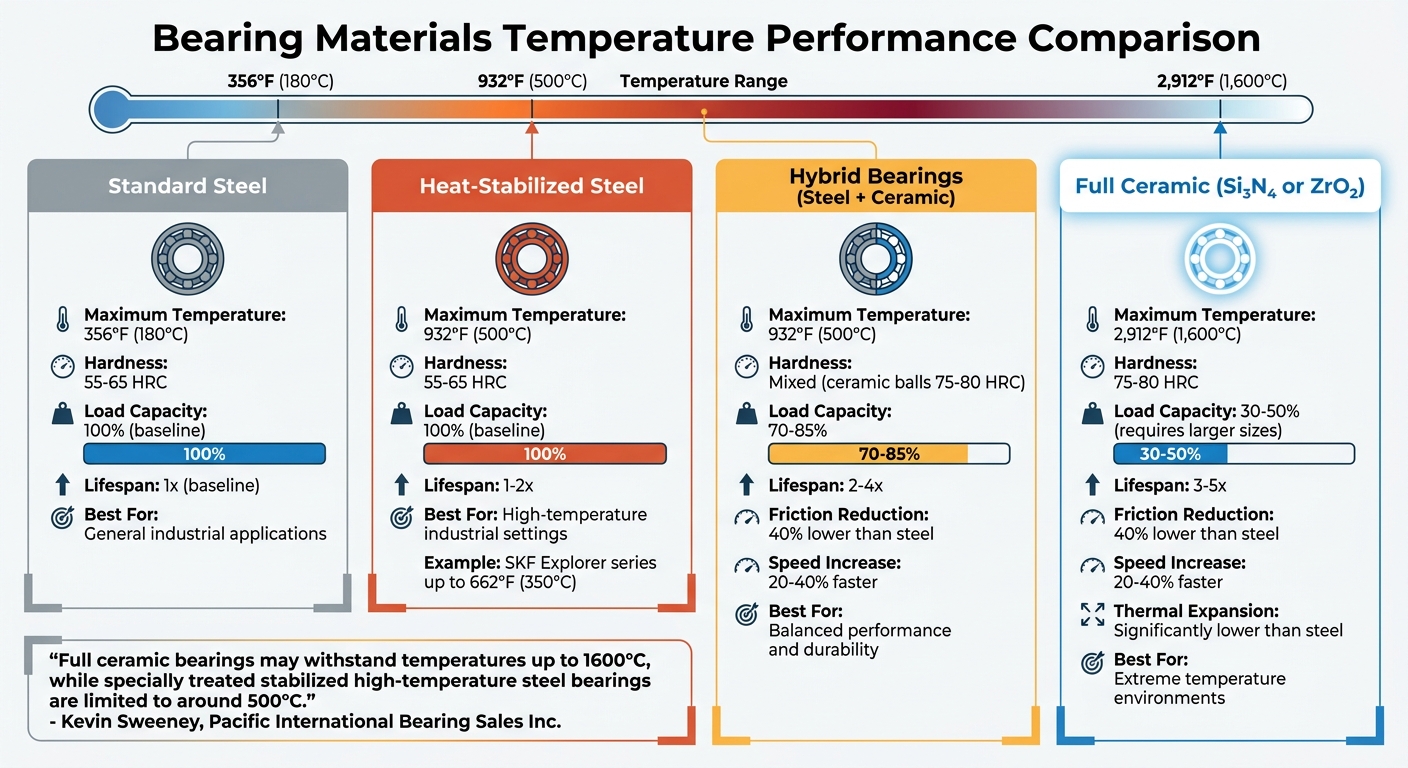
When dealing with high-temperature applications, the choice of materials is critical. The right material can mean the difference between a bearing that thrives and one that fails. Standard steel bearings can handle up to 356°F (180°C), but heat-stabilized steel extends that limit to about 932°F (500°C). For even higher temperatures, ceramic materials are essential, with some capable of withstanding up to 2,912°F (1,600°C).
Thermally stabilized steel alloys are a go-to option for many high-temperature settings. These alloys resist the structural changes - like the austenite-to-martensite transformation - that can distort bearings under heat. For instance, the SKF Explorer series incorporates optimized internal geometry and heat-stabilized steel, allowing it to perform reliably at temperatures up to 662°F (350°C). When temperatures approach 932°F (500°C), high-speed tool steel offers unmatched heat resistance, while martensitic stainless steel is ideal for environments requiring added corrosion protection.
Heat-Stabilized Steel Alloys and Ceramic Materials
Ceramic bearings, made from materials like silicon nitride (Si₃N₄) or zirconium oxide (ZrO₂), excel in extreme conditions. These materials experience far less thermal expansion compared to steel, reducing the risk of bearing seizure during temperature swings. Additionally, ceramic bearings boast friction coefficients about 40% lower than steel, which allows for operating speeds that are 20% to 40% faster. Their hardness - ranging from 75-80 HRC compared to steel's 55-65 HRC - translates to a lifespan three to five times longer under typical conditions.
However, full ceramic bearings come with limitations. They can only support 30% to 50% of the load capacity of steel bearings, which means you may need to use larger sizes when switching from steel to ceramic. Hybrid bearings, which combine steel rings with ceramic balls, strike a balance. These hybrids can handle temperatures up to 932°F (500°C).
"Full ceramic bearings may withstand temperatures up to 1600°C, while specially treated stabilized high-temperature steel bearings are limited to around 500°C." - Kevin Sweeney, Founder and CEO, Pacific International Bearing Sales Inc
Beyond choosing the right material, protective coatings play a crucial role in enhancing performance under extreme heat.
Protective Coatings for Extended Durability
When temperatures rise above 392°F (200°C), standard mineral greases break down due to oxidation. Protective coatings step in to provide lubrication where traditional greases fail. Silver-plated steel cages, for example, offer emergency lubrication in high-speed aerospace and automotive applications, where bearings may reach 608°F (320°C) and spin at over 200,000 rpm. The silver plating prevents metal-to-metal contact and maintains structural integrity even if the primary oil film degrades.
For even harsher environments, PVD (Physical Vapor Deposition) magnetron-sputtered coatings made from materials like molybdenum disulfide (MoS₂), tungsten disulfide (WS₂), or gold are highly effective. These coatings, which range from nanometers to micrometers in thickness, can handle continuous operation between 572°F and 842°F (300°C to 450°C). They conform to complex surfaces and remain stable in vacuum conditions where conventional lubricants would evaporate. Industries like welding and furnace manufacturing rely on bearings with PVD gold or MoS₂ coatings, enabling them to function at 842°F (450°C) - a temperature at which grease would completely fail.
Choosing the Right High-Temperature Lubricants
When it comes to extreme temperatures, picking the right lubricant is just as important as selecting heat-resistant materials. In fact, the performance of bearings under high heat heavily depends on the lubricant’s composition. While mineral oils dominate the market - making up roughly 95% of manufactured greases - they falter when temperatures climb. The effectiveness of a lubricant at high temperatures boils down to the combination of its base oil and thickener. For instance, highly refined mineral oils and synthetic hydrocarbons start to break down between 536°F and 608°F (280°C to 320°C), while metal soap thickeners degrade at even lower temperatures, ranging from 250°F to 430°F (120°C to 220°C).
For applications involving consistent exposure to high heat, synthetic base oils like PAOs (polyalphaolefins) and esters offer superior thermal and oxidative stability compared to mineral oils. When operating temperatures surpass 570°F (300°C), fluorinated hydrocarbon-based greases become essential, though their cost can run into hundreds of dollars per pound. The thickener also plays a critical role in performance: polyurea provides antioxidant benefits, calcium sulfonate resists rust and handles high temperatures, clay thickeners remain stable without melting, and silica thickeners can withstand dropping points up to an incredible 2,732°F (1,500°C) - though the base oil may burn off before reaching this limit.
"The selection must include consideration of oil type and viscosity, oil viscosity index, thickener type, stability of the composition formed by the oil and the thickener, additive composition and properties, ambient temperature, operating temperature, atmospheric contamination, loading, speed, relubrication intervals, etc." – Noria Corporation
With so many variables in play, careful comparison of lubricant types is essential to match the product to the application.
Comparing Lubricant Options
| Lubricant Type | Temperature Range | Maintenance Frequency | Best Application |
|---|---|---|---|
| Mineral Oil Grease | Up to ~300°F (150°C) | Frequent relubrication | General industrial use, high-volume applications |
| Synthetic (PAO/Ester) | Up to ~390°F (200°C) | Moderate intervals | Electric motors, industrial fans |
| Fluorinated Grease | Up to 570°F (300°C) | Extended intervals | Aerospace, vacuum environments, extreme heat |
| Solid Lubricants (Graphite/MoS₂) | Over 930°F (500°C) | Minimal (dry film) | Kilns, furnaces, chemical processing |
This table highlights the strengths of each lubricant type, helping to pinpoint the best choice for specific high-temperature conditions.
Best Practices for Lubrication Management
Using the right lubricant is only part of the equation; effective lubrication management is equally crucial. Start by measuring the actual bearing temperature with contact or non-contact sensors. This step ensures you’re addressing the true operating conditions rather than relying on ambient temperature estimates. Knowing whether the heat exposure is intermittent or continuous can help you decide between a mid-tier product with adjusted relubrication intervals or a premium synthetic lubricant for constant high-heat environments.
Avoid mixing grease types at all costs. Incompatibilities between different thickeners or base oils can lead to thinning, which might cause the lubricant to leak out of the bearing. The Arrhenius rate rule reminds us that chemical reactions double with every 18°F (10°C) temperature increase, making incompatibility issues even worse at elevated temperatures. To switch products, dismantle and thoroughly clean the system first. Additionally, over-greasing can be just as damaging as under-greasing. Excess grease generates heat through churning, accelerating the breakdown of the lubricant.
Environmental factors should also influence your lubricant choice. For example, if moisture is present, avoid water-soluble glycol-based greases, even if they claim to handle high heat well. In settings like drying ovens, where grease might drip onto products, it’s important to carefully balance relubrication volume to minimize contamination risks. By combining proper lubrication practices with the right materials and clearances, you can significantly extend the life of bearings in challenging thermal environments.
Optimizing Internal Clearance for High Temperatures
In high-temperature settings, the inner ring of a bearing heats up and expands more quickly than the outer ring. This happens because the housing dissipates heat more effectively than the shaft, leading to a reduction in internal clearance. If this thermal expansion isn’t accounted for during bearing selection, it can result in "negative clearance." This condition creates preload on the bearing, drastically shortening its lifespan, causing excessive heat, and potentially leading to seizure. Adjusting internal clearance, alongside using advanced materials and cooling systems, helps maintain bearing performance under such extreme conditions.
"Selecting an improper fit can cause bearing damage such as creep, while an improper clearance can cause bearings to seize." – NSK Global
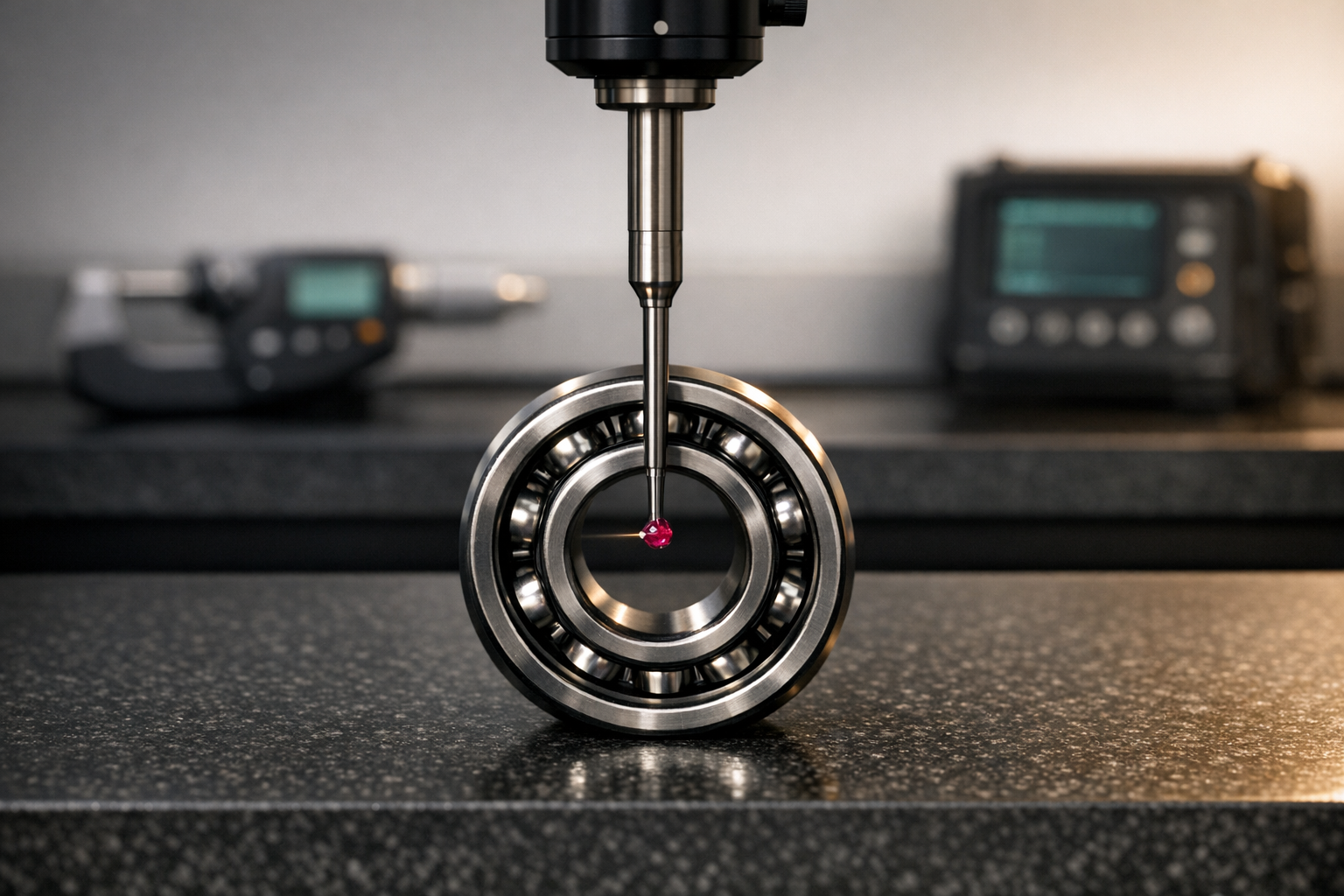
To counter these thermal effects, it’s crucial to understand the three stages of clearance: initial clearance (before the bearing is mounted), residual clearance (after mounting on the shaft and housing), and effective clearance (during operation). Effective clearance - the most critical - accounts for reductions caused by interference fits and thermal expansion. Technicians aim for an effective clearance slightly above zero to ensure safe operation margins.
Understanding Clearance Classifications
Radial bearing clearances are categorized by size, from smallest to largest: C1, C2, Normal (CN), C3, C4, and C5. For high-temperature applications, larger clearances like C3, C4, or C5 are typically needed to accommodate thermal expansion and avoid seizure. On the other hand, C1 and C2 are designed for noise and vibration reduction in loose-fit applications, making them unsuitable for high-heat environments. Normal (CN) clearance works well for moderate temperatures and standard fits.
A study by Schaeffler on a GE50-DO bearing demonstrated how an initial clearance of 60–120 μm could shrink to just 15 μm after accounting for maximum interference fits, even before factoring in thermal expansion.
Impact of Fitting Practices on Heat Generation
Tight interference fits can significantly reduce internal clearance before a bearing even starts operating, leading to immediate heat buildup. While tight fits are essential to prevent creep (the inner ring slipping on the shaft), they must be balanced carefully. For heavy or impact loads, opting for a larger clearance class, like C3 or C4, can help compensate for the added expansion during mounting.
Another factor to consider is the shaft's surface roughness. Press-fitting can cause plastic deformation of the shaft surface, unexpectedly altering the clearance. This makes it critical to calculate both residual clearance (post-mounting) and effective clearance (during operation) to prevent seizure during peak thermal loads. By targeting an effective clearance just above zero at maximum operating temperatures, the bearing can handle thermal expansion without risking failure. These precise fitting practices, paired with appropriate material and lubrication strategies, play a key role in ensuring reliable bearing performance under extreme heat.
sbb-itb-d28dc3f
Designing Cooling Systems for Bearing Applications
When adjusting internal clearances or selecting specific materials isn’t enough to tackle extreme heat, active cooling systems become a critical solution. These systems work alongside selected materials and lubricants to help extend bearing life by removing heat directly from the bearing housing. Choosing the best cooling method depends on factors like operating temperatures, available space, and budget.
Forced Air and Water-Cooling Techniques
Forced air cooling involves using fans or blowers to push high-speed air - typically between 2,000 and 6,000 feet per minute - over the bearing housing. This method is effective for temperatures up to 300°F (149°C) and can lower bearing temperatures by 20–60°F (11–33°C). For instance, in aerospace gas turbines, external axial fans have successfully reduced temperatures from 350°F (177°C) to 280°F (138°C), improving bearing life by 30–50%, based on thermal degradation models. The setup is straightforward, with costs ranging from $200 to $500 per bearing. However, its performance can drop by 20–30% in dusty or humid conditions where airflow is restricted.
Water-cooling systems use a circulating coolant - usually water or a water-glycol mix - through channels or jackets around the bearing housing. Thanks to water's high specific heat capacity (4.18 J/g°C), this approach is far more efficient than air cooling, achieving temperature reductions of 50–100°F (28–56°C). A U.S. aluminum extrusion plant reported a 40% increase in bearing lifespan after installing water jackets. These systems require a flow rate of 1–5 gallons per minute per bearing and are ideal for environments with temperatures exceeding 500°F (260°C). However, they involve more complexity, with initial setup costs ranging from $800 to $2,000. Additional components like pumps, heat exchangers, and corrosion-resistant materials (e.g., stainless steel) are also necessary.
"Effective cooling design can double bearing life in high-heat scenarios by keeping inner ring temps below 212°F (100°C)" – SKF Technical Director, 2023
In addition to these active cooling methods, passive solutions can also enhance thermal management in demanding applications.
Heat Sinks and Cooling Jackets
Heat sinks are passive devices designed to complement active cooling. These finned metal attachments, typically made of aluminum or copper, increase surface area for natural heat dissipation. They are bolted directly to bearing housings, and their effectiveness depends on factors like fin density (8–16 fins per inch) and material thermal conductivity. For example, aluminum provides a thermal conductivity of 205 W/m·K, while copper reaches 401 W/m·K for faster heat transfer. In heavy machinery, such as furnace pillow blocks, finned aluminum sinks help maintain temperatures below 250°F (121°C). Costs range from $50 to $200 per unit, and anodizing the surface can extend oxidation resistance to temperatures as high as 600°F (316°C).
Cooling jackets offer a more aggressive approach by encasing the bearing housing in a hollow shell where coolant flows continuously. Using 1/4–1/2 inch thick stainless steel jackets with spiral or counterflow channels can achieve up to 95% heat transfer efficiency. In aerospace applications, such as jet engine test stands, cooling jackets have reduced peak temperatures from 450°F (232°C) to 180°F (82°C), effectively doubling the mean time between failures. Installation involves O-ring seals, 1-inch ceramic fiber insulation, and temperature probes at the inlet and outlet. Retrofit kits cost between $300 and $1,000, making them a cost-effective option for critical applications.
At a U.S. Steel mill, water-cooled jackets on roller bearings cut operating temperatures from 420°F (216°C) to 220°F (104°C). This improvement extended bearing life from six months to two years - a 300% increase that saved the company $150,000 annually in replacement costs. To validate performance, tools like infrared thermography (accurate to ±2°C) and embedded thermocouples (Type K, ±1°C) can monitor surface and core temperatures. Aim for operating temperatures below 212°F (100°C), with no more than a 30°F (17°C) rise above ambient conditions.
These cooling methods, combined with regular monitoring and maintenance, ensure reliable bearing performance in high-temperature environments.
Monitoring and Maintaining Operating Conditions
Even with the best materials, lubricants, and cooling systems in place, the real key to extending bearing life lies in consistent monitoring and upkeep. Without keeping an eye on operating conditions, issues like lubrication failure or thermal expansion reducing internal clearances can sneak up on you - often with costly consequences. The process starts with setting a dependable temperature baseline before diving into maintenance routines.
Establishing Baseline Temperatures
Setting a stable operating temperature baseline is the first step in maintaining industrial bearings. Typically, these bearings operate at 40°F–80°F above the surrounding temperature, though in harsher environments, this can go up to 120°F above ambient levels. Record these baseline temperatures while the bearings are still new, and keep tracking temperature patterns to catch early warning signs of potential failure.
For accurate and continuous monitoring, high-precision sensors are your best bet. Set up dual-level alerts: one for a warning threshold below the maximum allowable temperature and another for shutdown to allow proactive maintenance. If you’re using multiple sensors, pay attention to temperature differences between zones and how quickly temperatures rise. These trends can often reveal issues like uneven loads, misalignment, or lubrication problems long before static thresholds would.
"Monitoring bearing temperature is crucial for maintaining the health and performance of industrial machinery. Temperature monitoring for bearings allows for real-time bearing temperature data, which can provide early warning of potential problems." – Nicole Chotain, Marketing and Sales Specialist, Temp-Pro
When combined with the material and cooling strategies discussed earlier, these monitoring techniques can significantly extend the life of your bearings.
Implementing Preventive Maintenance Practices
Temperature tracking plays a critical role in preventive maintenance, helping you act before problems escalate. Bearings designed for high temperatures need more frequent inspections due to faster material wear and lubricant breakdown. Essential maintenance tasks include:
- Inspect lubricants for signs of thermal damage, such as discoloration or crustiness.
- Check for any blockages in ventilation and confirm that housings are properly vented.
- Examine heat shields for wear or damage.
- Ensure seals are intact; consider upgrading to metal shields or heat-resistant alternatives if necessary.
Be cautious with grease - over-greasing can trap heat and increase friction, which defeats the purpose of regular maintenance. Use tools like induction heaters for installation and bearing pullers for removal to avoid mechanical damage. Acoustic monitoring is another helpful tool; unusual noises like grinding or rumbling often indicate impending failure. For specialized applications, such as those involving high heat or vacuum conditions, plasma cleaning is an effective way to remove organic residues without leaving behind harmful chemicals.
| Warning Sign | Physical Change | Likely Cause |
|---|---|---|
| Lubricant Color | Darkening or stiffening | Oxidation and additive breakdown |
| Operating Sound | Grinding, rumbling, whining | Internal wear or surface damage (spalling) |
| Temperature | Steady or sudden increase | Lubrication failure or clearance loss |
| Lubricant Odor | Burnt smell | Severe thermal degradation |
These maintenance practices are a natural extension of the advanced materials and cooling systems discussed earlier, ensuring your bearings remain reliable and efficient over time.
Conclusion
Prolonging the life of bearings in high-temperature environments demands a thoughtful mix of heat-resistant materials, specialized lubricants, precise clearance calculations, efficient cooling systems, and consistent maintenance practices. Each of these components plays a vital role in combating accelerated wear and dimensional instability. The process starts with selecting the right materials.
For instance, aerospace-grade steels like M50 and BG42 ensure dimensional stability, while ceramic balls made of Si₃N₄ can withstand extreme temperatures of up to 800°C (1,472°F). Since standard mineral greases degrade above 300°F, it's crucial to opt for specialty fluorinated greases (effective beyond 480°F) or solid lubricants such as MoS₂. Additionally, silver-plated steel cages not only maintain structural integrity but also offer emergency lubrication if the primary lubricant fails.
Thermal expansion can lead to bearing seizure, so precise clearance calculations are essential. To manage heat effectively, forced air or water-cooling systems help maintain safe operating temperatures. These measures, combined with regular monitoring, significantly reduce the risk of unexpected failures. As Emerson Bearing highlights, "Extreme temperatures can dramatically accelerate the bearing aging process", emphasizing the importance of setting temperature baselines and performing preventive maintenance.
"With reduced maintenance and replacement frequency, substantial costs are saved while improving overall operational efficiency." – ISK BEARINGS
Real-world industrial applications show that proactive engineering and consistent upkeep can significantly enhance bearing durability, improve uptime, and reduce costs, even in the most demanding conditions. By systematically applying these strategies, businesses can achieve measurable improvements in performance and efficiency.
FAQs
How do I choose between steel, hybrid, and full-ceramic bearings for high heat?
The choice hinges on the thermal and operational requirements of your application. Steel bearings are an affordable option and handle moderately high temperatures effectively, but they can deteriorate when exposed to extreme heat. Hybrid bearings, which combine ceramic balls with steel races, provide improved heat resistance and greater durability. For environments with exceptionally high temperatures, full-ceramic bearings are a top choice due to their excellent corrosion resistance. However, they come at a higher price and are less capable of withstanding shocks. Weigh factors like cost, operating conditions, and expected lifespan to make the best decision.
What’s the safest way to switch to a high-temperature grease without causing incompatibility?
To switch safely to a high-temperature grease, the first step is to confirm that it’s compatible with your existing grease or the materials used in your bearings. You can do this by consulting manufacturer specifications or using compatibility charts. Once confirmed, clean the bearings thoroughly to remove all traces of the old grease. This step is crucial because mixing incompatible greases can lead to breakdowns or even failures. Taking these precautions ensures a seamless and reliable transition to high-temperature grease.
How can I calculate the right clearance class (C3/C4/C5) for my operating temperature?
To select the right clearance class - C3, C4, or C5 - it's important to factor in the bearing's thermal expansion and the specific operating conditions. For high-temperature environments, higher classes like C4 or C5 are often preferred to avoid issues like tightness or excessive wear. Always consult manufacturer guidelines or standards such as ISO or ABMA, which provide charts and formulas to help align the clearance class with the expected temperature and load for the best performance.