Table of Contents

Rambo

Custom Bearing RFQ: 12 Details Buyers Must Send
A custom bearing RFQ should give the supplier enough information to check the design, price the work, and define acceptance criteria. Send the application and duty cycle, loads, motion profile, dimensions, fits, running requirements, materials, closures, lubrication, environment, life target, and order quantities. Attach a revision-controlled drawing when available, identify unknowns, and request a written list of assumptions before comparing quotes.
1. RFQ Scope and the Quick Answer
1.1 What a Custom Bearing RFQ Must Achieve
A useful request for quotation gives the supplier a design basis and gives the buyer a way to evaluate the response. Separate requirements that must be met from preferences the supplier may challenge, and identify anything still being measured. SKF's application data sheet illustrates the value of sharing the assembly and operating conditions alongside bearing information. Ask each bidder to return proposed specifications, exclusions, and open questions so a low price does not conceal an incomplete scope.
1.2 When a Standard Bearing May Be Enough
Check available bearing types and sizes before fixing a custom design. A catalog bearing may satisfy the requirement with a change to the surrounding shaft, housing, or sealing arrangement, while a custom feature may solve a constraint the machine cannot accommodate otherwise. Explain which dimensions or interfaces are fixed and which can change without redesigning the equipment. Use FHD's custom bearing product page as the starting point for a project inquiry, then request confirmation of the proposed construction and supply scope.
1.3 How Buyers and Engineers Share Requirements
Engineering should own operating limits, critical interfaces, and test criteria, while purchasing supplies quantities, required dates, and commercial terms. Give the supplier one technical contact who can resolve conflicting drawings or assumptions. Label the request as concept review, prototype quotation, or production quotation, because the required evidence changes at each stage. An agreed requirement sheet helps both teams decide whether an offer is ready for comparison or still needs clarification.
2. Detail 1: Application and Duty Cycle
2.1 Machine Function and Bearing Position
Describe what the machine does and where the bearing sits in the assembly. Include a sectional sketch showing nearby bearings, the drive, support spacing, and the direction of motion. Explain whether this bearing locates the shaft axially, supports an overhung component, or works with another bearing that shares the load. That context lets the supplier review the arrangement without assuming that every force acts directly on a single bearing.
2.2 Continuous, Intermittent and Oscillating Motion
State operating hours per shift, shifts per day, and the expected number of starts or cycles. For intermittent service, record how long the assembly runs and how long it rests during a typical cycle. Oscillating motion needs its angle, frequency, and dwell periods rather than a continuous-rotation speed alone. Include a simple time chart when motion changes during the process, so the design review reflects the actual duty.
2.3 Shock Events and Service Conditions
Identify events outside normal operation, including jams, impact loading, emergency stops, and transportation with the assembly stationary. Describe how often each event occurs and whether it must be survived without inspection or can trigger a maintenance check. Attach measured records when available and label estimated values as estimates. Keep installation damage separate from service loading, since preventing one may require an assembly change rather than a different bearing.
3. Detail 2: Loads and Their Directions
3.1 Radial, Axial and Moment Loads
Report forces with units and directions relative to the shaft. NSK distinguishes radial and axial loading: radial force acts across the shaft axis and axial force acts along it, while an applied moment needs its magnitude and the geometry through which the assembly reacts to it. Show the load location and bearing spacing rather than assigning an entire machine moment to one bearing without analysis. If a supplier calculates bearing reactions, request the calculation assumptions with the proposed selection.
3.2 Peak Loads Versus Repeating Loads
Supply normal, minimum, and peak loads together with the time or cycle share for each condition. A short overload and a sustained load should be identifiable in the data even when both appear in the same production cycle. Include the loading at startup, shutdown, and any reversal that changes the loaded zone. Ask the quotation to state the duty used for selection so competing offers can be reviewed against the same load history.
3.3 What to Provide When Loads Are Unknown
An unknown load should become an explicit engineering task in the RFQ. Share the machine layout, component weights, drive power, gear or pulley geometry, and any available force measurements that may help establish it. State who will calculate or measure the missing values and when the result will be available. A supplier may offer a preliminary concept using declared assumptions, but those assumptions need closure before a production design is approved.
4. Detail 3: Speed and Motion Profile
4.1 Operating and Peak Speeds
List the normal speed range and the highest speed reached, using revolutions per minute for rotation. Explain how long the bearing remains at peak speed and whether it reaches that speed under the maximum load. Identify which ring rotates and whether the shaft is horizontal, vertical, or changes orientation. For a linear or track-contact application, provide travel speed and the geometry needed to relate that motion to bearing rotation.
4.2 Starts, Stops and Reversals
Describe acceleration, deceleration, and reversal as part of the operating profile. A shaft that spends most of its time starting and stopping needs more context than its nameplate speed provides. Record cycle frequency, hold time, and whether the assembly can coast or is actively braked. Where motion is very small or infrequent, flag long stationary periods and external vibration for the supplier's review.
4.3 How Speed Affects Lubrication Questions
Ask for the proposed speed capability of the complete bearing configuration, including its closures and lubricant. A speed figure taken from an open-bearing catalog entry does not automatically apply to a modified sealed assembly. Describe available cooling, lubricant supply, and any allowable temperature rise during the test. Keep a separate record of the operating condition used to justify the supplier's proposal rather than treating a catalog limit as a machine acceptance result.
5. Detail 4: Dimensions and Space
5.1 Bore, Outside Diameter and Width
Give the bore, outside diameter, and width, then distinguish required dimensions from the available design envelope. Specify whether a dimension is nominal, a measured sample value, or a controlled drawing requirement. Timken's bearing selection process treats available space as one of the application constraints considered during selection. Request any proposed dimensional change in a marked drawing so its effect on the surrounding assembly is visible before pricing is accepted.
5.2 Shoulders, Chamfers and Mounting Features
Include shaft and housing shoulders, fillets, grooves, flanges, and fastening features that affect seating or retention. Show the location of oil holes, antirotation features, and installation-tool access where they are relevant. The bearing corner geometry and the mating fillet need to be checked together so the ring can seat against the intended shoulder. Provide the assembly drawing as well as the bearing drawing, since a correct standalone part can still conflict with a nearby component.
5.3 Units, Drawing Revisions and CAD Files
Put the drawing number, revision, units, and applicable notes on every quotation request. State which document controls if a CAD model, drawing, and measured sample disagree. Use FHD's overview of bearing tolerances as related reading, then identify the actual dimensional requirements for this part on the controlled drawing. Ask suppliers to flag unclear features rather than silently treating every model dimension as a manufacturing tolerance.
6. Detail 5: Shaft and Housing Fits
6.1 Mating Component Dimensions
Send the shaft-seat and housing-bore dimensions with their tolerance limits, materials, and relevant surface requirements. Include whether either component is hollow, thin-walled, split, or otherwise likely to behave differently during assembly. NSK's guide to fits and internal clearance explains why the bearing and mating components must be considered together. Have the supplier review the proposed fit for the stated application instead of selecting a universal shaft-and-housing fit from a generic example.
6.2 Fit, Alignment and Surface Conditions
Describe how the shaft and housing seats are aligned and how that alignment is verified. Record any expected shaft deflection, housing distortion, or movement between supports during operation. Fit review should include the load direction relative to the rings and the temperatures of the mating parts. Ask for drawing-level recommendations where changes are needed, so the machine builder can assess their effect on machining and assembly.
6.3 Assembly Method and Inspection Responsibility
Explain how the bearing will be installed, removed, and retained. Identify available presses, heaters, fixtures, and any restrictions on applying force to the rings or surrounding parts. Assign responsibility for checking the shaft and housing before installation, since the bearing inspection report cannot establish that those mating parts are correct. Include the approved assembly method in the production package and train the people who will use it before trial parts are fitted.
7. Detail 6: Accuracy and Running Requirements
7.1 Runout and Positioning Needs
Translate the machine's accuracy requirement into measurable bearing or assembly characteristics. Identify the datum, measurement location, and condition for radial runout, axial runout, or positioning repeatability where they matter. If stiffness is important, state the allowable deflection under a defined load rather than describing the bearing only as high precision. A tolerance class can be part of the specification, but it does not replace the machine-level acceptance requirement or independently establish load or speed capability.
7.2 Clearance and Preload Questions
Specify whether the requirement concerns the unmounted bearing, the assembled bearing, or its operating condition. Mounting interference and temperature differences can change internal clearance, so the supplier needs the mating fits and thermal conditions before recommending a value. If preload is required, define how it will be applied, controlled, and verified in the assembly. Avoid requesting both a generic clearance class and an unspecified preload without explaining how the two requirements relate.
7.3 Noise and Torque Test Conditions
Give noise, vibration, starting-torque, and running-torque requirements a test method and acceptance limit. Record speed, load, temperature, orientation, lubricant condition, and any run-in period used during measurement. Explain whether testing applies to the loose bearing or the complete assembly, because the results answer different questions. Agree on the equipment, sample quantity, and reporting format before asking suppliers to guarantee a result they cannot interpret.
8. Detail 7: Material Requirements
8.1 Rings and Rolling Elements
State a mandatory material grade when it comes from the design specification, and explain the reason for any restricted material. If the grade is open for selection, describe the corrosion, temperature, load, and wear concerns the proposal must address. Ask the supplier to name the ring and rolling-element materials separately when the construction uses more than one material. Evaluate the proposed combination as a complete design rather than assuming that a more expensive material improves every performance characteristic.
8.2 Cage and Seal Materials
Cages, seals, and other nonmetal components need the same environmental review as the rings. Provide lubricant details, cleaning chemicals, operating temperatures, and any restrictions on material contact with the process. Where a coating or heat treatment is requested, define its purpose, coverage, and the document needed to verify it. Have engineering approve substitutions explicitly, since a visually similar component may use a different material or treatment.
8.3 Material Identification and Traceability
Define the material evidence needed for sample approval and repeat orders. That may include a material declaration, specified test results, or certificates linked to an identified manufacturing batch, depending on the purchase requirements. State the required document type and language, and request separate pricing if special testing is needed. Traceability is useful only when the documents can be connected to the parts received, so agree on part marking or package identification at the same time.
9. Detail 8: Seals and Shields
9.1 Contaminant Exposure
Describe what the bearing must keep out and what lubricant it must retain. Fine dust, metal chips, splash water, cleaning spray, and immersion present different sealing questions. Show the position of any external seals, covers, or drainage paths around the bearing. Ask the supplier to assess the combined arrangement against the exposure instead of expecting a bearing closure to compensate for every weakness in the housing design.
9.2 Contact and Noncontact Options
Request a closure proposal that balances contamination control, lubricant retention, friction, and service access. Contact seals can add resistance to rotation, while noncontact closures rely on their geometry and the surrounding arrangement for protection. Specify low starting torque or frequent washdown as explicit requirements when either controls the design choice. Compare options using the stated operating conditions and do not assume a fixed percentage change in speed or friction for every bearing.
9.3 How to Confirm Suffixes with the Supplier
Treat a manufacturer's suffix as a reference to its own specification. Ask for a written description of the closures on each side, the seal or shield material, and any special grease or clearance included in the designation. A suffix that looks familiar may not mean an identical construction across suppliers or product families. Put the agreed configuration on the approved drawing or part specification so repeat orders are controlled by documented requirements.
10. Detail 9: Lubrication
10.1 Grease, Oil and Lubricant Retention
Identify the lubrication method and name the current lubricant when the machine already exists. For grease, provide the product designation and ask the supplier to specify the proposed initial fill and its basis. For oil, describe the supply method and the relevant operating conditions, including temperature and access to the bearing. NTN's lubrication guidance is a useful reference for discussing method and lubricant selection rather than requesting an undefined standard grease.
10.2 Relubrication Access and Intervals
Explain how lubricant reaches the bearing and whether maintenance staff can reach the lubrication point safely. Identify available automatic systems, grease lines, oil ports, and any restrictions on servicing during operation. If an interval has been established in the existing machine, share its conditions and maintenance history as evidence for review. Ask the supplier to distinguish the proposed bearing design from the maintenance assumptions used to evaluate it.
10.3 Compatibility and Clean Assembly
Tell the supplier when a new lubricant will encounter residue from another product or process chemical. Request a compatibility review before mixing lubricants, as Timken warns that mixing greases can impair lubrication, and include any cleaning or changeover procedure in the assembly instructions. State packaging and handling requirements that protect the prepared bearing before installation. If the process needs special cleanliness evidence, define the measurement and documentation rather than relying on the word clean as an acceptance criterion.
11. Detail 10: Environment
11.1 Temperature at the Bearing Location
Provide minimum, steady operating, and maximum temperatures at the bearing location when those values are known. Separate ambient temperature from bearing, shaft, housing, and lubricant measurements. Include exposure to nearby heaters, repeated thermal cycling, and the available cooling arrangement. If measurements are still pending, identify their locations and the condition under which they will be taken so the supplier can explain what remains unresolved.
11.2 Moisture and Cleaning Chemicals
List the liquids and cleaning products that can reach the bearing, including concentration and exposure conditions where available. Explain whether exposure is occasional splash, pressure washing, condensation, or immersion. State whether the machine must be dried, flushed, or relubricated afterward, because those maintenance steps affect the proposal. Request material and closure suitability for the described exposure without assuming that a stainless-steel ring alone makes the complete assembly suitable.
11.3 Dust, Corrosion and Storage Exposure
Include conditions that occur while the machine is idle as well as when it is running. Humid storage, outdoor installation, transport vibration, and extended shelf time may require different protection and handling instructions. Describe the contaminant type and where it originates, especially when the process generates abrasive particles close to the bearing. Agree on corrosion protection, packaging, storage limits, and any preparation required before installation as part of the order.
12. Detail 11: Service-Life Requirements
12.1 Duty-Based Life Targets
Express the desired service life in operating hours, cycles, or another unit that matches the duty. State what ends useful service, such as excessive play, unacceptable torque, leakage, wear, or a defined fatigue criterion. Ask the supplier to identify the calculation or test basis and the reliability assumptions behind any proposed life estimate, using Timken's life and load-cycle discussion as one reference for the engineering review. A calculated rolling-bearing fatigue life does not by itself establish lubricant life or guarantee that the assembly will reach the same interval in service.
12.2 Maintenance and Replacement Access
Describe the consequences of replacement and the work needed to reach the bearing. Include disassembly time, alignment work, lubrication access, and whether the machine can be stopped for scheduled service. Purchasing can use these factors to compare ownership costs alongside the quoted part price. Request a spare-parts and replacement plan for the proposed configuration when a change would affect future maintenance or interchangeability.
12.3 Validation Conditions and Failure Criteria
Set the conditions under which the design will be evaluated before production approval. Specify the relevant load, speed, motion, temperature, contamination, and maintenance assumptions for the trial. Define pass and fail criteria before testing so the team does not reinterpret an inconvenient result afterward. When an accelerated test is proposed, ask how it relates to the actual duty and what conclusions it can reasonably support.
13. Detail 12: Quantity and Order Stages
13.1 Prototype and Trial Quantities
Separate the number of parts needed for engineering samples, assembly trials, and production validation. Explain whether trial parts will be consumed in testing or must remain available as reference samples. Ask for the quantity required to complete the supplier's proposed development and inspection work. A sample quotation should state what it includes and what must still be approved before repeat production can begin.
13.2 Production Forecasts and Repeat Orders
Provide expected annual demand, typical release quantities, and the likely production ramp. Distinguish a planning forecast from a committed order, and state the period each figure covers. Request pricing at the quantities the business can realistically purchase, with any minimum order or stocking terms identified. Share expected repeat-order timing so the supplier can explain how it affects capacity planning and quotation validity.
13.3 Tooling and Setup Costs to Request Separately
Ask suppliers to separate piece price from engineering, tooling, setup, and special inspection charges. Clarify ownership, storage, maintenance, and replacement terms for any buyer-funded tooling. Request the effect of a drawing revision on those charges before committing to an unfinished design. This breakdown helps purchasing compare the initial order and repeat orders without assuming that every development cost is included in the unit price.
14. Sample Approval and Supplier Documentation
14.1 Dimensional Inspection and Report Fields
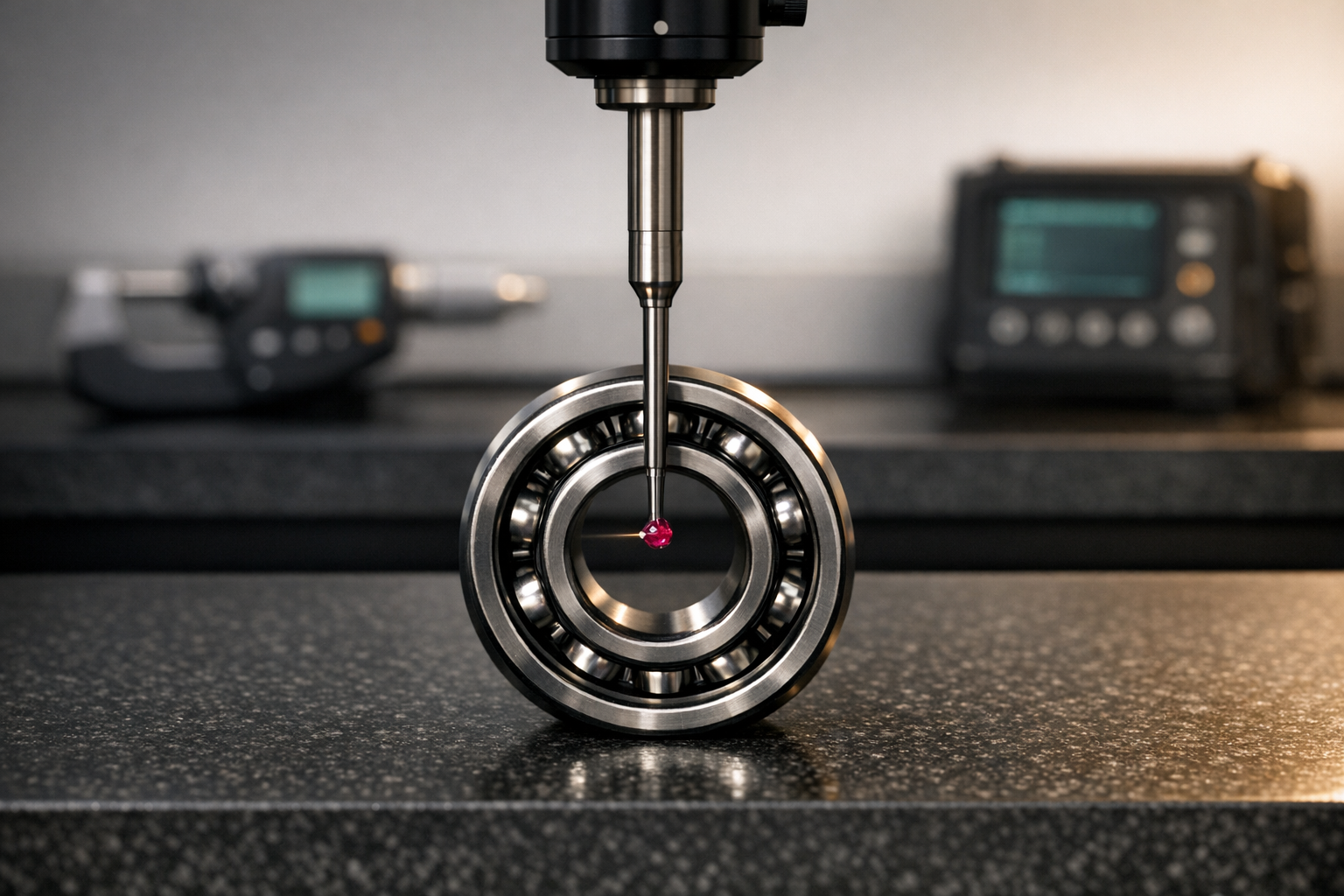
Build the sample inspection plan around the drawing's critical features and their acceptance limits. Require the report to identify the part, drawing revision, sample or batch, measurement method, and recorded result for each agreed characteristic. FHD's article on bearing inspection methods provides related reading, but the order must specify which inspections and documents apply to this project. Agree on sample size and disposition of nonconforming parts before the inspection begins.
| Approval item | Define before testing | Record at release |
|---|---|---|
| Drawing and configuration | Part number, revision, closures, lubricant and approved exceptions | Approved drawing/specification and purchase-order reference |
| Critical dimensions | Agreed features, datum scheme, method, limits and sample quantity | Results linked to inspected samples or batch |
| Material and traceability | Specified material evidence and identification method | Required documents matched to received parts |
| Functional trial | Defined load, motion, temperature, assembly and pass/fail limits | Test record and disposition of unresolved requirements |
| Production release | Approval owner, open issues closed, change-control requirement | Written release against controlled documents |
14.2 Application Testing Before Approval
Fit trial bearings into a representative assembly using the intended installation method. Check the characteristics that matter to the machine, including rotation, temperature, noise, positioning, leakage, or wear as specified in the test plan. Record the test conditions and any difference from the production configuration. Approval should state which requirements were demonstrated and which still need work, rather than treating a successful installation as proof of every performance requirement.
14.3 Change Control and Batch Identification
Define the information that must remain controlled after sample approval. Include the drawing revision, material and lubricant specification, closure arrangement, marking, and agreed inspection requirements. Require written review of proposed changes that affect those items, with responsibility assigned for approval and revalidation. Keep the approved sample records and batch identification together so a later issue can be investigated against the actual supplied configuration.
15. Quote Review and Delivery Planning
15.1 What Must Be Included in the Quotation
Request a quotation that identifies the part, drawing revision, configuration, quantities, and documents being offered. It should state price breaks, one-time charges, minimum order requirements, quotation validity, and any technical exceptions. Specify delivery destination, currency, and the agreed shipping terms so freight and other charges can be compared consistently. Move unresolved assumptions into a visible clarification list before placing the purchase order.
15.2 Drawing Approval, Production and Shipping Milestones
Ask for a schedule that distinguishes engineering review, drawing approval, tooling, sample manufacture, testing, production, and shipment. Identify which milestone starts the quoted lead time and which buyer decisions can change it. Work backward from the required arrival date while allowing time for inspection and trial approval. Obtain confirmation of the production schedule for the approved design instead of carrying an early estimate forward after the requirements change.
15.3 How to Compare Offers on the Same Requirements
Compare each offer against the same revision of the requirement sheet. Mark an item as compliant, an approved alternative, an exception, or unanswered rather than judging the offers from their summaries alone. Evaluate the total expected order cost, including samples, documentation, tooling, freight, and the maintenance implications of the proposed design. A technically acceptable quotation with clear responsibilities gives the buyer a sounder purchasing basis than an attractive price attached to an ambiguous scope.
16. Copyable RFQ Template and Buyer FAQs
16.1 Which 12 Details Should You Include in the RFQ?
Use the form below to collect the application, loads, motion, dimensions, fits, running requirements, materials, closures, lubricant, environment, life target, and quantities. Add the project reference and technical contact, then attach the controlling drawing and assembly information. Leave an unknown field clearly marked with the person responsible for resolving it. Ask the supplier to answer against the same twelve fields so missing information remains visible during quote review.
| RFQ detail | Buyer entry | Requested supplier response |
|---|---|---|
| 1. Application and duty | [Machine function, bearing location, hours/day, cycles and abnormal events] | Identify the application and duty used for design review. |
| 2. Loads | [Radial/axial forces, applied moments, directions, peaks, duration and units] | State selection assumptions and any missing load data. |
| 3. Speed and motion | [Normal/peak rpm or travel speed, ring rotation, oscillation and starts/stops] | Review the complete configuration against the motion profile. |
| 4. Dimensions and space | [Bore, OD, width, mounting features, available envelope; drawing number/revision] | Return the proposed drawing and identify dimensional deviations. |
| 5. Shaft and housing fits | [Seat dimensions/tolerances, materials, alignment and assembly method] | State the mating-component requirements or proposed changes. |
| 6. Running requirements | [Runout, stiffness, clearance/preload, torque/noise limits and test conditions] | Identify measurable acceptance limits and the test basis. |
| 7. Materials | [Required grades, cage/seal materials, treatments and document requirements] | Name the proposed materials and flag substitutions. |
| 8. Seals and shields | [Exposure, external sealing, closure on each side, retention needs] | Describe closure construction and its intended function. |
| 9. Lubrication | [Method, lubricant designation, supply/fill requirements and maintenance access] | State the lubricant proposal and maintenance assumptions. |
| 10. Environment | [Bearing/ambient temperatures, chemicals, moisture, dust and storage] | List the environmental conditions included in the proposal. |
| 11. Life and validation | [Hours/cycles, end-of-life criterion, test conditions and maintenance plan] | Explain the estimate or test basis and remaining validation. |
| 12. Order stages | [Sample/trial/release quantities, annual forecast and target arrival date] | Separate unit price, one-time charges, minimum quantity and schedule. |
16.2 Can You Get a Quote Without a Complete Drawing?
You can request a preliminary review with a dimensioned sketch, assembly photographs, an existing part number, or a sample description. Explain which information is measured and which remains uncertain, and ask what additional data the supplier needs before issuing a firm quotation. A physical sample can help describe an interface, but it does not reveal every material, tolerance, or operating requirement. Approve a controlled specification and the agreed validation plan before releasing production parts.
16.3 How Should You Request FHD Review and Approve the Order?
Send the completed requirement sheet and relevant files through FHD's contact page, with the required quantities and arrival date. Request written confirmation of feasibility, the proposed specification, documentation, sample plan, costs, and lead-time assumptions. Resolve technical exceptions with the person who owns the machine design and record that approval before placing the order. Release production against the approved documents, then inspect the received parts using the acceptance criteria agreed during the RFQ.